Carcano is the frequently used name for a series of Italianbolt-action military rifles and carbines. Introduced in 1891, this rifle was chambered for the rimless 6.5×52mm Mannlicher-Carcano cartridge (Cartuccia Modello 1895). It was developed by the chief technician Salvatore Carcano at the Turin Army Arsenal in 1890 and called the Model 91 (M91). Successively replacing the previous Vetterli-Vitali rifles and carbines in 10.35×47mmR, it was produced from 1892 to 1945. The M91 was used in both rifle (fucile, sing.; fucili, pl.) and carbine (moschetto, sing.; moschetti, pl.) form by most Italian troops during the First World War and by Italian and some German forces during the Second World War. The rifle was also used during the Winter War by Finland, and again by regular and irregular forces in Syria, Libya, Tunisia, and Algeria during various postwar conflicts in those countries.
The Type I Carcano rifle was produced by Italy for the Japanese Empire prior to World War II. After the invasion of China, all Arisaka production was required for use of the Imperial Army, so the Imperial Navy contracted with Italy for this weapon in 1937. The Type I is based on the Type 38 rifle and uses a Carcano action, but retains the Arisaka/Mauser type 5-round box magazine. The Type I was used primarily by Japanese Imperial Naval Forces and was chambered for the Japanese 6.5×50mm Arisaka cartridge. Approximately 60,000 Type I rifles were produced by Italian arsenals for Japan.
History
Although this rifle is often called "Mannlicher-Carcano", especially in American parlance, neither that designation nor the name "Mauser-Parravicino" is correct. Its official designation in Italian is simply Modello 1891, or M91 ("il novantuno"). The magazine system uses en bloc charger clips which were originally developed and patented by Ferdinand Mannlicher, but the actual shape and design of the Carcano clip is derived from the German Model 1888 Commission Rifle.
Until 1938, all M91 rifles and carbines were chambered for the rimless 6.5×52mm Modello 1895 cartridge, using a round-nose metal case bullet of 160 grains weight at approximately 2,000-2,400 ft/s muzzle velocity, depending upon barrel length. At least one small arms authority noted inconsistencies in powder types in arsenal-loaded 6.5×52mm military ammunition, often with different powder types and ammunition lots intermixed within a single clip of ammunition.<ref>Dunlap, Roy F., Ordnance Went Up Front, Samworth Press (1948), pp. 47: Dunlap, a small arms ordnance expert serving with the Foreign Weapons section in the Royal Ordnance Corps, broke down many Italian 6.5×52 mm cartridges, and sometimes found different components in the same rifle clip—up to four different types of smokeless powder, using different size flash holes for the primer in an attempt to regulate the burning speed and resultant velocity.</ref> The practice of intermixing powder types and ammunition lots in clipped rifle ammunition was generally avoided by arsenals of other nations, as it generally resulted in varying bullet velocities and excessive bullet dispersion on the target.
After reports of inadequate performance at both short and long ranges<ref>Dunlap, Roy F., Ordnance Went Up Front, Samworth Press (1948), pp. 47-48: The 6.5mm Carcano had reportedly proved inadequate in stopping charges of native tribesmen for a number of years, prompting various stop-gap solutions such as brass-jacketed multiple projectile or frangible explosive bullets, apparently for use against tribesmen in colonial conflicts.</ref><ref>Weeks, John, World War II Small Arms, New York: Galahad Books, p. 47: the 6.5mm's blunt bullet and relatively low velocity also gave poor long range performance in machine guns, compared to the cartridges used by most other nations.</ref> during the campaigns in Italian North Africa (1924-1934), and the Second Italo-Abyssinian War (1934), the Italian army introduced a new short rifle in 1938, the Modello 1938, together with a new cartridge in 7.35×51mm caliber. In addition to the slightly larger caliber, Italian ordnance designers introduced a spitzer-type bullet for the new cartridge, with the tip filled with aluminum to produce an unstable (tumbling) projectile upon impact in soft tissue (a design most likely copied from the .303 British Mk VII bullet).
However, the Italian government was unable to successfully mass-produce the new arms in adequate quantities before the onset of war, and in 1940, all rifle and ammunition production reverted to 6.5 mm, but no 7.35 mm Mod. 38 rifles nor carbines were ever re-barreled to the old 6.5×52mm caliber. Some Italian troops serving on the Russian front were armed with 7.35 mm Mod. 1938 rifles, but exchanged them in 1942 for 6.5×52 mm arms.<ref name="Miller"/>
(Left to Right) 7.92mm Mauser, 6.5mm and 7.35mm Carcano
Approximately 94,500 7.35 mm Modello 1938 rifles were shipped to Finland, where they were known as Terni carbines.<ref name="jaeger">The Finnish Army 1918–1945: Rifles, Part 6 Three Mausers and One Terni Jaeger Platoon Website</ref> They were primarily used by security and line-of-communications troops during the Winter War of 1939–1940, though some frontline troops were issued the weapon.<ref name="jaeger"/> According to reports, the Finns disliked the rifle.<ref name="jaeger"/> With its non-standard 7.35 mm caliber, it was problematic to keep frontline troops supplied with ammunition, and its non-adjustable rear sight (fixed for 300 m) made it ill-suited for use in precision shooting at the varied ranges encountered by Finnish soldiers during the conflict.<ref name="jaeger"/> Soldiers also complained that the ammunition demonstrated excessive bullet dispersion on the target.<ref name="jaeger"/> Whenever possible, Finnish soldiers discarded the weapon in favor of rifles acquired on the battlefield,<ref name="jaeger"/> including standard models of captured Soviet-made Mosin–Nagant rifles. The latter at least had the advantage of using commonly available 7.62×54mmR ammunition. By the outbreak of the Continuation War, Finnish Army headquarters had got the message. The remaining Mod. 1938 7.35 mm rifles were issued to the Finnish Navy, as well as anti-aircraft, coastal defense, and other second-line (home front) troops.<ref name="jaeger"/>
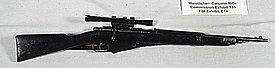
In 1941, the Italian military returned to a long-barrelled infantry rifle once again (slightly shorter than the original M91), the Carcano M91/41. True sniper versions never existed, but in World War I a few rifles were fitted with telescopic lenses and issued for service use (World War II scoped rifles were strictly prototypes).
Since the 1980s, several lots of Moschetti M91/38 TS (special troops' carbines) chambered for the German 8×57mm Mauser sS heavy ball round, have appeared on the surplus markets. Two small batches of Moschetti M91/38 TS carbines shows barrels marked 1938 and 1941, but they were not used at these times with any Italian forces, and their peculiar serial numbering suggests that these might just be rebored unused surplus barrels that were converted with other ones after 1945. Many 7.92 mm Carcano carbines were apparently exported to Egypt after World War II, where they served as drill and training carbines. Several also bear Israeli armed forces markings. The occasionally used model moniker "Model 1943 (M43)" for these converted 7.92mm rifles is wrong, as they were never so designated by the Italian military.
German forces captured large quantities of Carcanos after Italy's capitulation in September 1943. It was the most commonly issued rifle to the German Volkssturm ("People's Militia") units in late 1944 and 1945.<ref name = "Yelton">{{#invoke:citation/CS1|citation
|CitationClass=book
}}</ref>
After World War II, Italy replaced its Carcano rifles first with British Lee-Enfields and then with the US .30 caliber (7.62 mm) M1 Garandsemi-automatic rifle which the Italians labeled the 'Model 1952 (M52). Finland sold all of its approximately 74,000 remaining 7.35 mm M91/38 Carcano rifles on the surplus market. As a consequence, large quantities of surplus Carcanos were sold in the USA and Canada beginning in the 1950s. In Italy, the Polizia di Stato retained the rifle, retiring it from service in 1981. Captured 6.5mm Carcano rifles were used by Greek forces post-war, with ammunition supplied by U.S. Western Cartridge Co. Some were also converted to 6.5×54mm Mannlicher-Schönauer, one of the standard cartridges of the Greek military at the time.
The original Carcano Modello 1895 cartridge (6.5×52mm), was also used in World War I-era machine guns in the Modello 30 light machine gun; the latter was employed in Abyssinia and in World War II by Italian troops until the Armistice. In 1935 the 8×59mmBreda cartridge was adopted for some Italian heavy machine guns (rechambered Fiat-Revelli, Breda M37, Breda M38); its longer range and heavier projectile proved much more effective in combat, particularly against motorized troops.
During the Libyan Civil War in 2011, many rebels went into battle with their personally-owned weapons, including old bolt-action rifles and shotguns. Of these, Carcano-style rifles and carbines have been the most frequently observed style of bolt-action rifle. They were predominantly used by rebels in the Nafusa Mountains. These old weapons saw combat once again due to the rebels' limited access to modern firearms. Additionally, some Libyan rebels preferred to use their familiar hunting weapons over the more modern, yet unfamiliar, assault rifles available.<ref>حد ثوار جبل نافوسه يستعمل بنذقية جده الايطاليه وعمرها اكثر من 100 سنة</ref><ref>{{#invoke:citation/CS1|citation
|CitationClass=news
}}</ref> According to Al-Fitouri Muftah, a member of the rebel military council overseeing the western mountain front, as many as 1 in 10 rebels in the region were armed with World War II-era weapons.<ref>{{#invoke:citation/CS1|citation
|CitationClass=news
}}</ref>
All variants used the same Carcano bolt action, fed by an en-bloc clip; the rifles and carbines had different barrel lengths and differences in stocks and sights depending on barrel length.<ref>H.H.B. Smith, Small Arms of the World, Stackpole, 1966, 8th ed., pages 476, 477.</ref>
Fucile di Fanteria Modello 1891 (long infantry rifle Model 1891, detachable knife bayonet, adopted in 1891 in 6.5×52mm caliber) 30.7 inch barrel.<ref name="Site">{{#invoke:citation/CS1|citation
|CitationClass=web
}}</ref>
Moschetto da Cavalleria Mod. 91 (6.5×52mm carbine with integral folding bayonet, adopted in 1893) 17.7 inch barrel.<ref>Julio S. Guzmán, Las Armas Modernas de Infantería, Abril de 1953</ref>
Moschetto per Truppe Speciali Mod. 91 (or 6.5×52mm M91 TS, carbine for special troops (TS = Truppe Speciali). These included machinegun, mortar and motorcycle crews, adopted 1897) 17.7 inch barrel.<ref name="Site"/>
Moschetto di Fanteria Mod. 91/24 (6.5×52mm carbine, modification of the original Mod. 1891 with shortened barrel and altered rearsight blade, adopted in 1924) 17.7 inch barrel.<ref name="Site"/>
Moschetto per Truppe Speciali Mod. 91/28 (lightly altered M 91 6.5×52mm carbine, adopted in 1928) 17.7 inch barrel.<ref name="Site"/>
Moschetto per Truppe Speciali con Tromboncino Mod. 91/28 (modified 91/28 coupled with a 38.5 mm grenade launcher) 17.7 inch barrel.
Fucile di Fanteria Mod. 1938 (Model 1938 short rifle adopted in 1938 in 7.35×51mm caliber, fixed sights, detachable folding knife bayonet) 20.9 inch barrel.<ref name="Site"/> File:Moschetto 91 - 38.jpgCarcano Model 1891/38 Carbine
Moschettos Mod. 1938 (folding bayonet) and Mod. 1938 TS (detachable bayonet) carbine versions of Model 1938 short rifle in 7.35×51mm, 17.7 inch barrel.Carcano Model 1891/38 short rifle (Fucile di Fanteria) with a 4-power Ordnance Optics scope used by Lee Harvey Oswald to assassinate John F. Kennedy
Fucile di Fanteria Mod. 91/38 (Model 1938 short rifle chambered in 6.5×52mm caliber since 1940) This is the model (stamped "1940" to show manufacture date) owned by Lee Harvey Oswald. From 1940 the Moschetto Mod. 1938 and Mod. 1938 TS were also made in 6.5×52mm.
Fucile di Fanteria Mod. 91/41 (6.5×52mm short infantry rifle, adopted in 1941, adjustable sights) 27.2 inch barrel.<ref name="Site"/>
Type I Rifle (6.5×50mm long infantry rifle, produced for export to Japan, adjustable sights)
 |size=|sizedefault=frameless|alt=}}


_crowned.svg)


.svg)


.svg)
.svg)