Station 5 Activity: Difference between revisions
m (1 revision imported) |
No edit summary |
||
| (One intermediate revision by the same user not shown) | |||
| Line 5: | Line 5: | ||
# Choose '''One (1)''' Renaissance Artist and '''One (1)''' of their Art Pieces | # Choose '''One (1)''' Renaissance Artist and '''One (1)''' of their Art Pieces | ||
# You may click a picture for an in depth study | # You may click a picture for an in depth study | ||
# Complete an | # Complete an Art Analysis Worksheet in your packet. | ||
== Background == | == Background == | ||
Latest revision as of 15:36, 10 May 2025

Italian Renaissance Artists
Directions:
- Read the Background on Renaissance Artist Below
- Choose One (1) Renaissance Artist and One (1) of their Art Pieces
- You may click a picture for an in depth study
- Complete an Art Analysis Worksheet in your packet.
Background
The period of the Renaissance (14th and 16th centuries) brought with it many important changes in the social and cultural position of the artist. Over the course of the period there is a steady rise in the status of the painter, sculptor, and architect and a growing sympathy expressed for the visual arts. Painters and sculptors made a concerted effort to extricate themselves from their medieval heritage and to distinguish themselves from mere craftsmen.
At the beginning of the Renaissance, painters and sculptors were still regarded as members of the artisan class, and occupied a low rung on the social ladder. A shift begins to occur in the 14th century when painting, sculpture, and architecture began to form a group separate from the mechanical arts. In the 15th century, the training of a painter was expected to include knowledge of mathematical perspective, optics, geometry, and anatomy.
A major development in the Renaissance is the new emphasis on the realistic description of figures and objects in painting and sculpture. The call to "imitate nature" involved an almost scientific examination of optical phenomena. In order to make figures and objects appear three-dimensional, forms were "modeled" employing the optical principles of light and shade. These correctly rendered three-dimensional figures and objects were placed in a three-dimensional illusionistic space created through the newly developed device of linear perspective.
The knowledge and use of scientific methods placed painting and sculpture on a new basis that was intellectual, theoretical, literary, and scientific. Painters and sculptors could now claim that their profession required intellectual ability and knowledge. This permitted the claim that they were superior to mere craftsmen, and that painting and sculpture should be recognized as liberal arts. Painters and sculptors also argued that they stood equal to poets; poetry and rhetoric, of course, were accepted as liberal arts. Part of the basis for this claim was the notion that painting and poetry were "sister arts", a concept the Renaissance developed from Horace's dictum Ut pictura poesis ("as a painting, so a poem"), and Simonides' description of painting as muta poesis ("silent poetry") and poetry as pictura loquens ("painting that speaks").
It is through this association with the poets that the concept of the "artist" as we know it begins to emerge. During the Renaissance the revival of Plato and Platonism helped spread the notion of the divine inspiration of the poet, which Plato compared with that of the religious prophet. According to Plato, poets and musicians, prophets, were divinely inspired (a term originally meaning to breathe or blow into, and now understood as meaning to be filled with supernatural power or energy) and infused with enthusiasm ("en-theism" meaning possessed by a god, supernatural inspiration, prophetic or poetic frenzy). In effect, the gods inspired, or spoke through, poets and musicians in same way god also spoke through prophets: to prophesy is to utter with divine inspiration.
The ancients believed that poets and prophets were inspired by a tutelary deity or attendant spirit, which the Romans called genius, that communicated to the world through chosen individuals. In the Renaissance, the source of inspiration became identified not with some pagan god or antique muse but with God himself.
It was at this time that artists such as Michelangelo began to be described by their contemporaries as "divine". At the same time there emerged the important of the artist as creator, a word formerly reserved for God alone. In the 16th century the new image emerges of the artist as genius, giving to eccentric behaviour, or even slightly mad. The artist also appears as an intellectual given to abnormal modes of thought, and regarded as an inspired and special individual. At the same time, the artist's work was regarded as unique and imbued with the artist's divinely-inspired creativitiy; in certain cases, an artist's work became the object the object of special pilgrimage and reverence. This attitude has perhaps grown over the centuries.
Masaccio
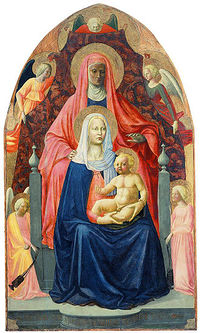
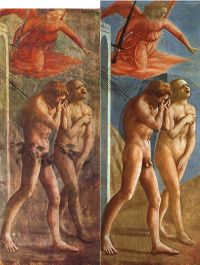
Born in 1401, died in 1428. Perhaps one of the most influential artists of the Renaissance. Historians claim that he, along with Donatello and Brunelleschi, inspired the style of art that typifies art of the period. In his 27 years on the planet, he developed a style that used perspective in a way that created an illusion of three-dimensions--a significant change from the flat style of painting that typified medieval art. His most famous work can be found in the Brancacci Chapel in Santa Maria del Carmine in Florence.
 |
 |
|
| The Tribute Money (1424) | Virgin and Child with Saint Anne (c.1424) | The Expulsion (1426–1427) |
Donatello
Born in 1386, died in 1486. Famous for many things including the youthful sculpture of David in Florence. A less famous work in the city is the brass pulpits he build for the Old Sacristy of San Lorenzo which was built by Brunelleschi. Like Masaccio, Donatello was one of the earliest artists working with the idea of perspective. His method was sculpture and he brought dramatic shapes to life with his skills.
 |
 |

|
| Equestrian Monument of Gattamelata (1450) | David (1430) | Saint John the Evangelist (1409–1411) |
Leonardo da Vinci
Born 1452, died 1519. His most famous works are the Mona Lisa and the Last Supper which are works in oil. He had a nature that was careful and precise, so that he never hurried to finish a work. He developed what are regarded as technical, manual skills that were so excellent that few artists in history have rivaled his ability. He had an exceptional intellect and fascination with the world around him. Besides his paintings, he left us a legacy of detailed drawings of the human anatomy, plans for a tank, helicopter, ideas on the construction of multi-level canal and road systems. Because he was an artist and a scientist at a time when both art and science, he has come to characterize the ultimate "Renaissance Man."
 |
 |
 |

|
| The Baptism of Christ (1472–75) | The Last Supper (1498) | Mona Lisa or La Gioconda (1503–1517) | Leonardo's study of a foetus in the womb (c.1510) |
Michelangelo Buonarroti
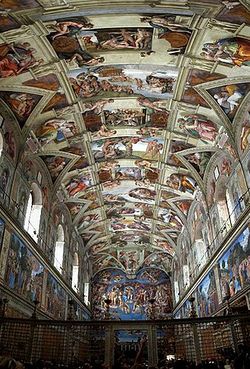
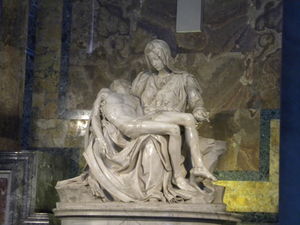
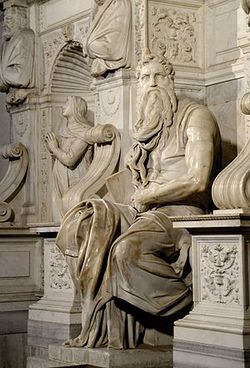
Born 1475,died 1564. In the 89 years that he lived, Michelangelo created many of the works of art that we think of when we think of the Renaissance. A skilled painter who spent many years completing the frescoes that adorn the Sistine Chapel, Michelangelo had trained as a sculptor and created two of the world's greatest statues--the enormous David and the emotional Peita.
 |
 |
 |
|
| David (1501-1504) | Sistine Chapel Ceiling (1508-1512) | Pietà(1498-1499) | Moses (1513-1515) |
Titian
Born in c. 1487, died in 1576. The most famous painter from Venice at the start of the 16th century. Trained by Giovanni Bellini, He was noted for use of color and for the use of thick, dramatic brush strokes. Among his famous paintings is Bacchus and Ariadne
 |
 |

|
| Allegory of Prudence (c.1565–1570) | The Rape of Europa (c.1560-1562) | Assunta (1516–1518) |
Botticelli
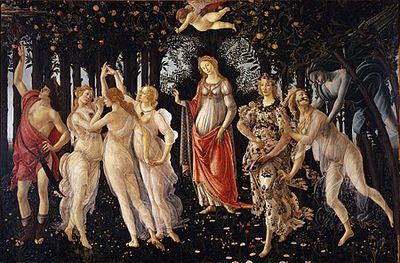
Born 1445, died 1510. His best paintings are a series of mythological topics including the Birth of Venus and Mars & Venus, the Roman gods which reflected the return of Renaissance thought to its classical roots.
 |
|
| Birth of Venus (c. 1470s or 1480s) | Primavera (1482) |
Caravaggio
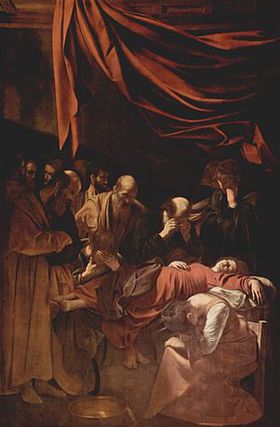
Born in 1573, died in 1610 A notable painting is his Death of the Virgin displayed in the Louvre, with the dramatic quality that was found in most of his works. He used foreshortening, shadowing and detail to portray scenes that drew out the emotions of the viewers. Caravaggio is often given credit for inspiring the Renaissance painters of northern Europe including Rembrandt.
 |
|
| David with the Head of Goliath (1609-1610) | Death of the Virgin (1601–1606) |
Ghiberti
Born in 1378, died 1455. Exceptional bronze sculpture, most famous for being selected to do the doors to the baptistry of the doors of the Duomo in Florence, being chosen over such artists as Brunelleschi and Donatello. Some art historians define the entries submitted in this contest as the beginning point of Renaissance art. Ghiberti spent 21 years doing the north doors. The year after he completed those doors, he was commissioned to do the east doors. He spent the next 28 years producing the brass panels depicting the Old Testament that complete those doors which Michelangelo described as the "gates of Paradise." He also sculpted St. Matthew and St. John the Baptist out of bronze for the Orsanmichele in Florence.

|
| Gates of Paradise (1425-1452) |
Giotto
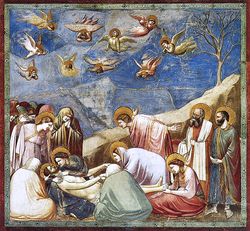
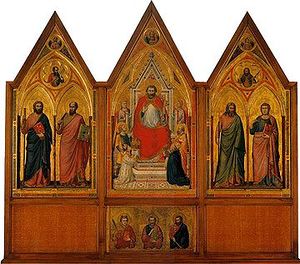
Born in 1267, died in 1337. Painted the Life of St. Francis of Assisi which is identified as one of his earlier works. Though an artist of the medieval period, he influenced such greats as Michelangelo and Raphael because he introduced some of the earliest solutions to creating the illusion of three-dimensionality in paintings and because his way of composing his paintings so effectively conveyed the the subject he was painting. Besides his work as an artist, he is famous for designing the Campanile (tower) of the Florence Duomo
 |
 |
 |

|
| Lamentation of Christ (1306) | Giotto's Campanile (1334) | Stefaneschi Triptych (c.1313-1320) | Baroncelli Polyptych (c.1334) |
Raphael
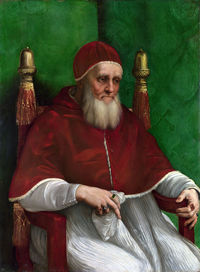
Born 1483, died 1520. Popular with the popes of the period, Raphael decorated the papal apartments of Julius II, continued to do so under Leo X and, following Bramante, served as architect of St. Peter's. He is credited with revolutionizing portrait painting because of the style he used in the portrait of Julius II. He also designed the "cartoons" that are on the tapestries of the Sistine Chapel. A tour of the Vatican Museums should include the Raphael Rooms where you can see some of the artist's works (though Raphael died suddenly on Good Friday, 1520, before all the work was completed and much of it was finished by his students). In his painting The School of Athens, he reflected the classical influence upon Renaissance art, but he also paid tribute to the men who inspired him by using the faces of da Vinci, Bramante and Michelangelo as philosophers participating in the debate between Plato and Aristotle.
 |
 |
 |

|
| School of Athens (1509-1511) | Julius II (1511-1512) | Sistine Madona (1512) | Mass at Bolsena (1512) |

